Hello my friends,
A few days ago I had a three hour gap between two meetings for work. The first was in The Hague and the second was in Amsterdam. Poor planning from my part perhaps... but not all is bad... In between these two cities lies the old city of Haarlem.
I decided to use this gap to visit the Frans Hals museum in Haarlem. Which, besides a wonderful collection paintings by Frans Hals and his contemporaries, also houses one of the few remaining cabinet houses of the 17th and 18th century still in existence today.
And they are proud of that fact because they even mention the dollshouse explicitly next to the main entrance of this museum! And rightly so don't you think?
With the time needed for driving. Parking and walking to and thro the museum there was an hour and a half left to visit the museum. Not by far enough to have a decent look at the different collections . But enough for the dollshouse!
As you can see it stands against the endwall of a long room with only one entrance. With the dimmed lighting and the tiled floor it looks quite reverend. Almost like a Catholic altar in a private chapel!
Only the pews are missing.
Finaly a proper degree of respect of displaying the fruits of our special hobby. :-) Well, it is very special but lets not get carried away too much.
What sets this cabinet apart from the other remaining cabinet houses are the 2 sets of double doors. All houses have the original set of doors belonging to the cabinet they are built in. Although they are usualy taken ooff the cabinet and stored away to display the interior better. But not in this case. The reason for that choice is the following.
Behind these outer doors is a set of 2 inner doors. These are painted to resemble the front facade of a grand house. Inserted into these doors are the windows through which you can peer into the rooms laying behind them if the doors are still shut. It is, as far as I know, the oldest of this type in the Netherlands. At least it is the only one surviving to this day. And that is why they show the cabinet house with all four doors in place.
The inner doors with the facade do not extend over the cellar floor. Those 3 rooms were originally hidden from view. On both front legs you see a crank. When Sara Rothe had opened both sets of doors and had shown all the rooms to her guests, two footmen would start turning those cranks. And to the surprise (and delight?) of the unsuspecting guests the whole Cabinet house would start to rise up. Revealing the hidden 3 rooms in the cellar stock!
Unfortunately the mechanism does not work anymore. But we can stil admire the rooms because the fake front drawer panels have been removed. And luckily so! For the kitchen and the diningroom are quite stunning rooms. I am not going to discuss all the rooms here. Just my favorites.
Hidden behind a door in that diningroom is the only loo in this house. A strange place according to our standards perhaps. But if you think that it was not unheard of in the grandest houses of the day to have guests urinate behind a screen in the same room. (quite handy because then a full bladder won't mean you can no longer participate in the dinner conversation...) Than this placement is less awkward.
Not that we will have such oddities in Huis ter Swinnendael however... And luckily for the Zonneschut's not less than three are planned there. not counting the chamber pots and the 'thunder boxes' in some rooms.
And come to think of it. The loo's in the other cabinet houses, when present, are situated in the kitchens....
The most famous room of this house in books and on the internet, is the one where guests would be entertained. Called here 'Kamer met rood moor' the red room. With "moor" being an old Dutch name for moiré or watered silk. This room is popular in the interner too because of the fabulous and sumptuous display of miniature silverware in the back wall.
It even is used in the 2002 book "Dollshouse Style" by Kath Dalmeny as an example to make your own 18th century continental roombox. Complete with projects to remake key parts of this interior.
Some of these projects I plan on making For Huis ter Swinnendael.
For a 17th century Bedroom in the same book she uses the childrens bedroom with a domed canopy bed from the Dollshouse of Petronella Oortman in the Rijksmuseum. That bed is also on my to do list... But that is for another day and post!
Apart from the mouth watering silver pieces, the combination of the red silk with the gilt cream wallpanels are very popular unto this day. It conveys the delicious feeling of grandeur and luxury.
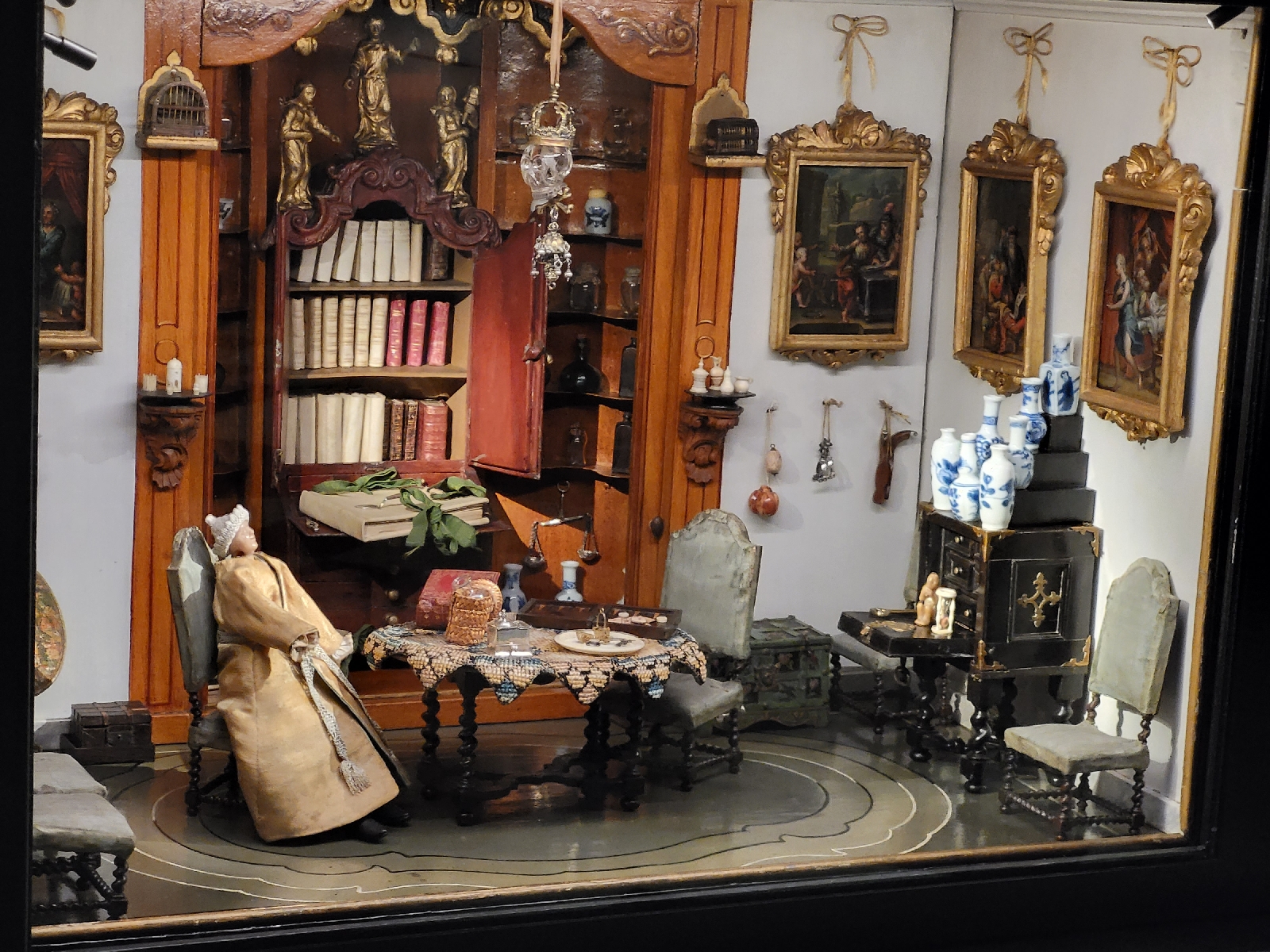
On the other side of the hall, opposite of the 'kamer met rood moor' lies the room of 'Astrologus Ludeman'. On the table lies a urine bottle in a woven basket. There are learned volumes in the alcove, as well as glass bottles and porcelain jars with ingredients for medicins. Which you associate with doctors. But, above the table hangs a crystal skull with a golden crown and on the table stands a gameboard used for gambling. That does not quite fit into the scene...
Astrologus Ludeman was a real person. Working as a doctor/ quack/ astrologer of German origin and made a lot of money in Amsterdam at the time of Sara Rothe. Selling his remedies and healing incurable ailments and all that to the wealthy patricians of the city. Many contempories thought he was a fraud, but Ludeman had wealthy patrons who supported and protected him. There is always someone who really wants to believe...
It is not sure if Sara believed in him and his tricks or not. So, is the subject of this room to revere or to ridicule Ludeman? Noone knows for sure. To me it feels like neither of the two. It could just be the set up for a doctors visit where the doctor is named after a fashionable and therefor recognisable figure of the day.
Whatever the reason for Sara to name this the room of Astrologus Ludeman, this set up does invite the guests who are shown the cabinet house to talk about what they think or know about this figure of some notoriety. I can imagine that mentioning his name alone would start (lively but polite) gossip "Have you heard...", "rumors have it..." and "I was told that...." and such.
My personal favorite however of the rooms in this house is not the "Kamer met rood moor" or the "Kamer van astrologus Ludeman". No, my favorite is the room called "de beschilderde kamer" or the painted room. Named so because of the painted scenes on the walls and ceiling. Many rooms in Dutch houses with this fancy and costly treatment were called 'painted room' of it was not called by another name.
The eastern rug here is also painted on the floor (just like in the "kamer met rood moor" but with a different design.) this however has nothing to do with the name of the room. Here paint is used to simulate a real knotted carpet in miniature.
The walls are painted with italianate landscapes and the ceiling is painted with a trompe l'oeuil of a domed ceiling. You can see that last one better on the picture below. Such a handsome little room!
The last room I want to show you is the one below. It is a bedroom with bedsteads hidden behind curtains. A nice detail (for me) is the subtle use of trompe l'oeuil painting. And I am not talking about the faux marble fire surround, which is quite delicate, although not as striking as the ones in the rooms shown above. No I mean the panneled walls. The raised panels on the chimney breast and above the bedsteads are repeated on the closet door in between the two bedsteads. But it is not... The raised panel on the door is simulated with paint. A light or a dark line outlining the panel on the door, that is all. The other four panels are real as you can see.
The doll of the child was once supervised by a maid who was ironing stockings. So this room with the glded mirror is not a mauds room or a laundry room, but the childrens bedroom.
What is also special about Sara Rothe is that she assembled not one but two cabinet houses. The second one stands in the Kunstmuseum in The Hague. That will be the subject of a visit in the near future. Stay tuned.
Huibrecht